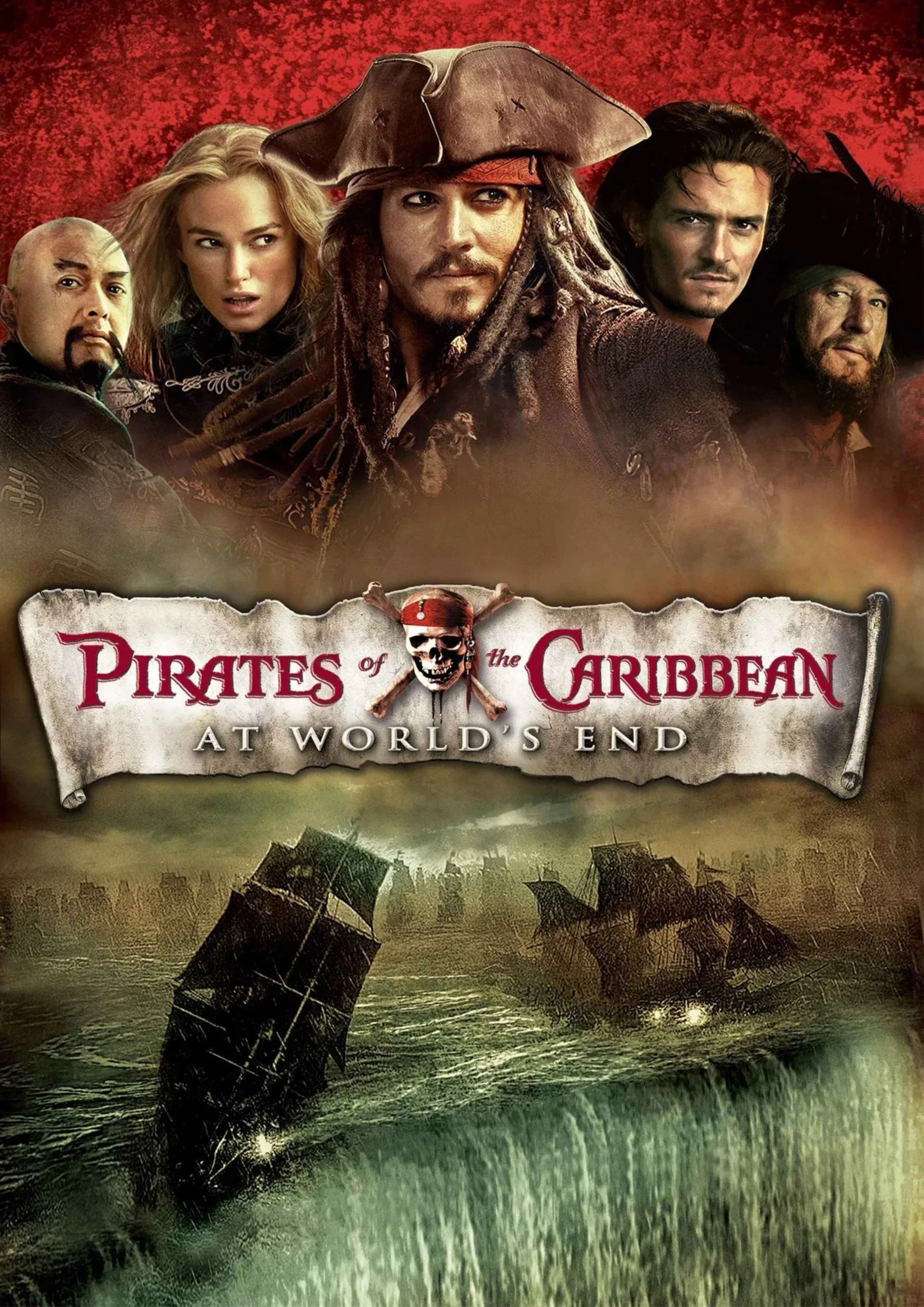
Pirates of the Caribbean: At World’s End (2007) Movie Review
Synopsis:
Jack Sparrow (Johnny Depp) is now lost to Davy Jones’ locker. His former crew must now journey into the unknown to save him. Meanwhile, Lord Cutler Beckett (Tom Hollander), of the East India Trading Company, threatens to end piracy. Sparrow and his crew must unite the pirate lords in one final battle for freedom.
Review:
Context and general thoughts:
Gore Verbinski’s third Pirates of the Caribbean film is, without any doubt, his most ambitious.
At World’s End introduces many ideas, making its plot seem too convoluted at times.
Story:
This film’s story has many moving parts. Take the introduction of the pirate lords and the nine pieces of eight.
Though it allows for an expansion of the universe, its inclusion may seem unnecessary to some audiences.
As an example, earlier in the film, Will Turner (Orlando Bloom) reveals that Jack Sparrow is one of the pirate lords.
Whilst this adds a new layer to Jack’s standing amongst pirates, it’s a very sudden reveal. There was also no prior mention of this in any of the other films.
This may make the reveal seem pointless, despite the interesting lore behind it. This may also make the film’s story seem less focused as a whole.
Characters:
As for the pirate lords and nine pieces of eight, they remain unique concepts.
Each pirate lord, as an example, has one piece of eight amongst them. This is revealed later on in the film during a gathering at their fortress, Shipwreck Cove.
These pieces are then used to awaken the sea goddess, Calypso, later on in the film.
Much of the film hints at Captain Barbossa (Geoffrey Rush) using her powers against their enemies.
One of the film’s reveals is that the mysterious Tia Dalma (Naomie Harris) was Calypso all along.
Much of her screentime involves building up to this reveal, and her relationship with Davy Jones (Bill Nighy).
Though this amounts to one scene between the two, it’s well-acted.
It’s in this scene where Davy Jones becomes human for a brief moment.
Whilst it’s brief, audiences get a glimpse of the man he used to be. Bill Nighy is also able to convey contempt and vulnerability in just one scene.
Despite being hidden beneath his monstrous octopus form, viewers are still able to read these emotions. This is thanks to ILM’s near-flawless CGI and visual effects.
Visuals and CGI:
This film’s distinctive visuals are present throughout most of the film.
Take one scene where Jack Sparrow and his crew turn the Black Pearl upside down.
For context, this is where they have to escape Davy Jones’ locker through unconventional means.
As the Pearl is turned upside down, the visuals show the vast blue ocean and bright sky.
Each one is flipped on itself, giving a unique visual. At World’s End also introduces a new location, Singapore, displaying its oriental nature well.
This film’s most impressive visual effects-focused achievement is the Maelstrom battle during the film’s climax.
As the Black Pearl and Flying Dutchman trade cannon fire, swords clash on deck.
Amongst the chaos, Jack Sparrow and Davy Jones duel on the Dutchman’s mast.
All of the action is well-framed, not once losing sight of the various factions involved.
As a whole, some viewers may find the amount of visual effects disorienting. If they’re willing to ignore them, this scene is a blast.
Despite its impressive visuals, it’s not as vibrant as the previous two films.
This is because of its more muted colours overall. Overall, this gives the film a distinctive look.
Saying that, others may miss the more varied colour palette of the first two entries.
Action:
Despite this, the film’s more muted tone fits the action. This is both well-shot and choreographed.
Whilst not being as inventive as the previous film, it maintains a clear sense of direction.
Soundtrack/score:
Accompanying the action is Hans Zimmer’s epic soundtrack. This is, by far, one of his most accomplished works.
Each piece has a distinct melody, giving the film much personality. Take one of his pieces titled “Singapore” as an example.
To convey its oriental nature, Zimmer used an instrument called an erhu. With one simple note, he draws the viewer into his world.
Another standout piece of Zimmer is titled “At Wit’s End”, used at many points throughout the film.
Its triumphant use of horns is one of the film’s more inspiring tracks.
Yet another standout piece from Zimmer is titled “I Don’t Think Now Is the Best Time.”
These are incorporated into the final Maelstrom battle and the death of Lord Cutler Beckett.
Hans’ epic use of horns, trumpets, and other help signify the climactic nature of the film.
It’s also during his track that Will Turner and Elizabeth Swann have an impromptu marriage.
It’s a sweeping piece of music that makes the scene stand out more.
Characters:
When it comes to Will and Elizabeth, each gets a definitive ending in this film.
Will becomes captain of the Flying Dutchman, whilst Elizabeth waits for his return to shore.
Their final scene together in this film makes for a worthwhile conclusion to their story.
Orlando Bloom and Keira Knightley also give competent performances, despite certain moments not landing.
Take when Elizabeth rallies the crew of the Black Pearl to war. Though she’s meant to convey passion, some of her line delivery can come across as forced.
As per usual, Johnny Depp proves why he was made for Jack Sparrow. He displays quirkiness, unpredictability, and charm all in one.
There’s also a moment towards the film’s conclusion where he displays genuine shock. For a character that doesn’t display that emotion much, it was welcome.
One scene of his that can confuse is when Jack’s in Davy Jones’ locker. For the viewer, Jack is seen interacting with other versions of himself.
Though the scene makes for some good comedy, it doesn’t serve much of a purpose otherwise.
Other characters, such as a returning Captain Barbossa, are worthwhile additions.
Geoffrey Rush, as usual, gives a very enthusiastic performance as the character.
He also has some comedic interactions with Johnny Depp’s Jack that are fun to watch.
Returning to the cast is Tom Hollander as Cutler Beckett. As he has more screen time, Tom conveys Beckett’s cunning nature well.
He also receives what is, perhaps, the film’s most iconic death. It’s in this scene where he realises that he’s been outmatched.
Beckett watches as the Black Pearl and the Flying Dutchman bombard his ship, the HMS Endeavor, with cannon fire.
Rather than retaliate, Beckett accepts his death. As he walks down the steps of his ship, cannons send pieces of wood flying across his path.
It’s a striking visual, giving Beckett an almost heroic sendoff. For a character so despised, this is a surprising yet effective choice.
Joining the cast is Hong Kong actor Chow Yun-fat as the pirate lord Sao Feng. His appearance is recognisable, with battle scars across his face.
Chow gives the character much intensity, despite not having much screen time. For audiences wanting to invest in his character, the film doesn’t allow for that.
This film’s juggling of characters and their many plotlines can be difficult to comprehend. This is evident in the first half, where multiple deals are made.
For first-time viewers, this can make for a confusing watch. For those rewatching the film, these issues may become more forgivable.
This film’s action-packed second half and strong conclusion may also help to alleviate those issues.
Conclusion:
In conclusion, At World’s End serves as a spectacle worth investing in. Its epic soundtrack and well-framed action make for many entertaining moments.
Performances across the board are also good. Much of this is down to Johnny Depp and Geoffrey Rush’s charismatic efforts.
Orlando Bloom and Keira Knightley also do a commendable job with their material.
Aside from his brief time onscreen, Chow Yun-fat gives Sao Feng enough intensity to entertain audiences.
As usual, Bill Nighy conveys many emotions through Davy Jones. This is made even more impressive through the film’s visual effects.
This is more than evident when capturing new locations and the film’s climactic Maelstrom battle sequence.
Whilst these are impressive, the film’s introduction of new concepts may confuse certain viewers. This can impact the plot’s pacing overall.
For those who can accept these flaws, At World’s End is an epic whirlpool of pirate adventure.
Action Reaction score:
Characters - 7.5/10
Story - 6.5/10
Action - 8/10
Visuals and CGI - 8.5/10
Soundtrack - 9/10
Overall score: 7.9 out of 10