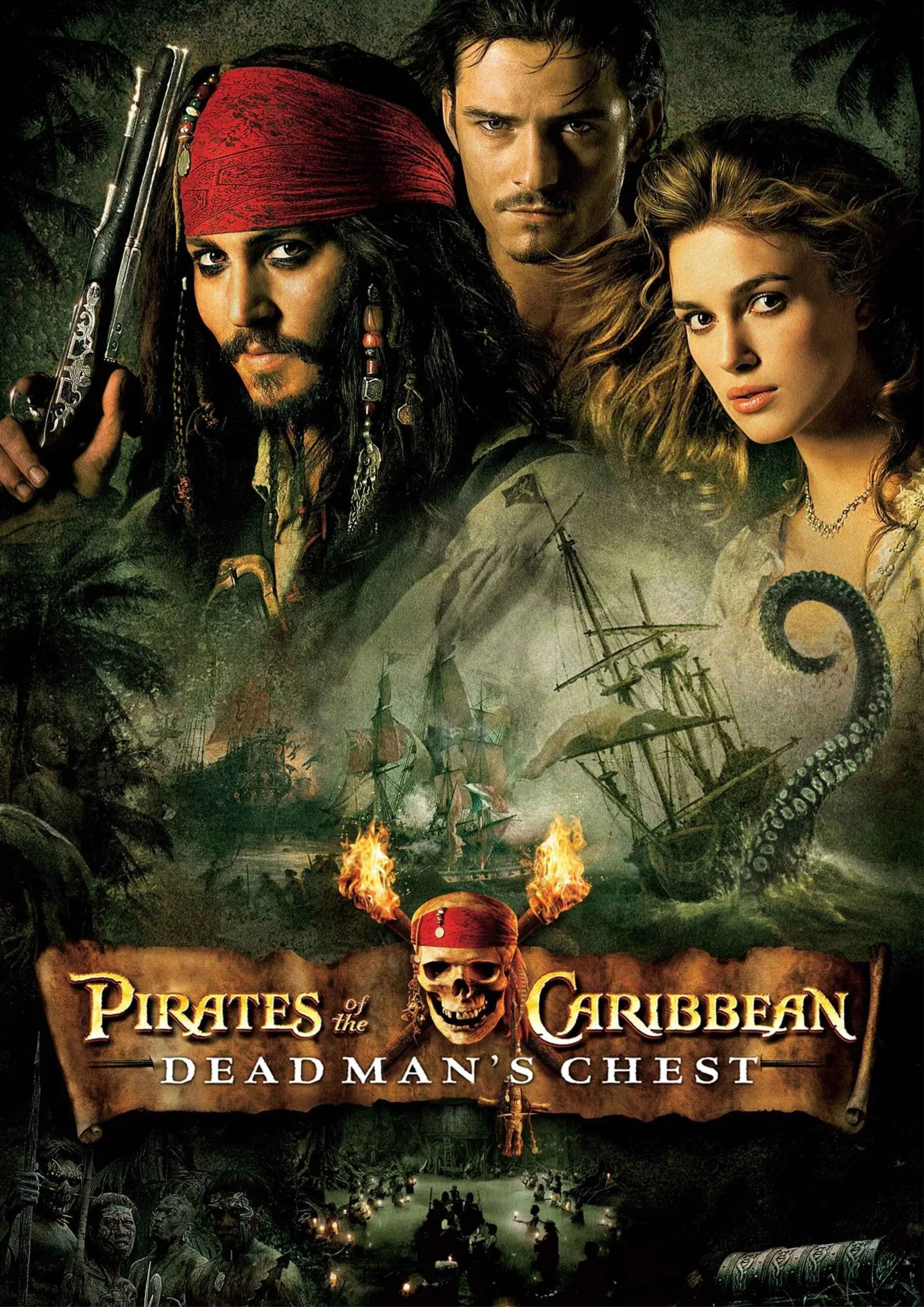
Pirates of the Caribbean: Dead Man’s Chest (2006) Movie Review
Synopsis:
Jack Sparrow (Johnny Depp) returns to captain the Black Pearl. This time, he owes a blood debt to the captain of the Flying Dutchman, Davy Jones (Bill Nighy). To avoid a lifetime of servitude, Jack seeks out Jones’ beating heart inside the Dead Man’s Chest.
Review:
Context and general thoughts:
As with most sequels, Dead Man’s Chest is grander in scope and scale when compared to its predecessor.
As a whole, this makes for many impressive action set pieces.
Visuals and CGI:
Its CGI and visual effects, thanks to ILM (Industrial Light and Magic), produce groundbreaking effects.
Take the introduction of the supernatural sea captain, Davy Jones (Bill Nighy), as an example.
His stature alone is intimidating, with the floorboards creaking under the weight of his presence.
Jones’ monstrous form is revealed under the orange glow of a pipe that he lights.
His face is that of an octopus, with each tentacle having their own unique movement.
Alongside the atmospheric lighting that the scene provides, viewers take in the details. Davy then utters the following words, “Do you fear death?”
This communicates to the audience that, despite Jones’ frightening appearance, he wants to save souls from torment.
Though it soon becomes clear that servitude under Jones is worse than death.
This becomes apparent when Will Turner (Orlando Bloom) meets his cursed father, Bootstrap Bill (Stellan Skarsgård).
It’s in this scene where Will is punished for a mistake. Rather than allowing a member of Jones’ crew to punish Will, Bootstrap takes it upon himself.
In one of the film’s more brutal scenes, Bootstrap lashes Will with repeated strikes of a whip. Its sound design alone makes the scene unnerving.
This is another element of the film that works. Take this film’s introduction of the Kraken as an example.
Piece by piece, the Kraken destroys a naval ship. Along with it, the weight of its tentacles comes crashing down.
This immerses the audience further, adding to the scene’s intensity.
Though the Kraken is well-utilised, a close-up of the creature near the film’s conclusion appears soft in detail.
This could have been a sign of the film’s age and the Kraken’s sheer size. Saying that, the rest of the film’s effects are first-rate.
Soundtrack/score:
Also adding to the film’s effects is Hans Zimmer’s score. For context, he takes over the compositions from the previous composer, Klaus Badelt.
For his piece titled “The Kraken” in particular, Zimmer’s most prominent instrument is the use of a pipe organ.
This note hits once the Kraken breaks a naval vessel in half.
It signifies to the viewer that the creature is an unstoppable force that every sailor of the sea fears. Zimmer also brings quieter notes in his piece titled “Davy Jones.”
It uses several notes of a musical box to signify the characters’ tragic nature.
Though an organ is also used in this piece, the musical box notes are the tracks’ most recognisable moments.
Saying that, there are moments where some audiences feel that Zimmer’s music is too bombastic.
Whilst much of his film music is in this style, others may have hoped for less action-heavy music.
Saying that, Zimmer’s score makes the film’s already inventive action more engaging.
Action:
Dead Man’s Chest includes many standout action set pieces, which are well-framed.
One of which involves a three-way sword duel, which soon moves to a rotating wheel.
For context, the characters in this scene are Jack Sparrow, Will Turner, and a returning James Norrington (Jack Davenport).
Each one of them is fighting over Davy Jones’ chest, each having a reason to take it. With clear stakes, it makes each character’s action in the scene matter.
Despite the inventive stunt work, others may question how believable the physics of the scene are.
If audiences are willing to ignore this, it’s a fun scene to witness. This is also helped by the film’s performances overall.
Characters:
As usual, Johnny Depp continues to have fun with his Jack Sparrow character.
Though he’s much more comedic in this film, Johnny embraces this well. This helps with his varied facial expressions.
Other performers, such as Orlando Bloom and Keira Knightley, are more comfortable in their roles here.
They have more agency, which helps progress the plot. This is despite them not being able to match Johnny Depp’s charisma.
Jack Davenport as James Norrington also gives a good performance.
For context, he lost his commission with the Royal Marines in pursuit of Jack Sparrow.
Davenport displays desperation well, giving his character more personality. Another highlight is Bill Nighy voicing Davy Jones.
He gives the character instant presence, voicing him with a commanding Scottish accent.
His line delivery is confident and pronounced. This makes him one of the film’s most consistent performances.
Despite his face being hidden through visual effects, Nighy gives Jones many facial expressions.
This is thanks to ILM’s inventive use of CGI and Nighy’s performance.
Despite a strong performance, Nighy doesn’t have much screen time as the character. This may have been because of budget limitations by ILM.
Saying this, some fans may have wished that Nighy had more time to showcase his talents.
Stellan Skarsgård also gives a commendable performance as Bootstrap Bill. In his short time on screen, he’s able to convey pity and distress well.
Story:
As a whole, this film’s performances are good. Saying that, its extensive runtime and inconsistent pacing leave less time for development.
Take the film’s scene on Pelagostos Island as an example. As a positive, it makes for some good, if absurd, physical comedy with Johnny Depp.
On the other hand, the scene serves little narrative purpose in the grander story. Somehow, Jack becomes their leader, believing him to be a God in human form.
Although viewers understand how Jack got there, little attempt is made to explain his standing with the tribe.
He’s able to speak their language despite having no prior setup for this.
If more context had been provided, this scene would’ve felt less redundant as a whole.
More context could have also been provided for Elizabeth Swann’s sudden ability to wield a sword.
This is present during a brawl in Tortuga, where she engages in combat with several armed men.
By this, several viewers may suspect that Will had taught her this skill.
Saying that, this isn’t revealed until later on in the film. This may be a minor gripe amongst certain audiences, though context would’ve helped.
As the film also attempts to juggle many plot lines, it jumps around quite often.
After Pelogostos Island, audiences go from islands, ships, and action set pieces often.
Though this helps give the film variety, some audiences may have wanted more time to settle in.
For those who can ignore this, Dead Man’s Chest’s runtime may not frustrate them.
Conclusion:
As with the first, Dead Man’s Chest contains varied action and high-quality production values. This is more than evident with the motion capture and CGI for Davy Jones.
Each tentacle of his octopus face moves with conviction. This makes Nighy’s already consistent performance even more of a standout.
Complementing the visual effects are the film’s creative and well-shot action sequences.
Despite some questionable physics at times, they’re fun enough to ignore. Hans Zimmer’s varied and bombastic score also adds to the action.
With tracks such as “The Kraken”, Hans conveys power and a sense of urgency. With his “Davy Jones” track, Hans conveys sorrow and tragedy.
Though viewers may appreciate the variety, others may have wanted less action-heavy music. Saying that, his score should please most fans.
As a whole, the film can falter due to inconsequential scenes and a lack of context. Its extensive runtime may also prove problematic for some.
Saying this, Dead Man’s Chest is a sequel worth diving into for franchise fans.
Sam’s Action Reaction score:
Characters - 7/10
Story - 6/10
Action - 8.5/10
Visuals and CGI - 9/10
Soundtrack - 8.5/10
Overall score: 7.8 out of 10